Yonsei-RAMO-Yberg AI-Native RAN Integration & Testing Capabilities
- Seong-Lyun Kim
- 7월 25일
- 2분 분량
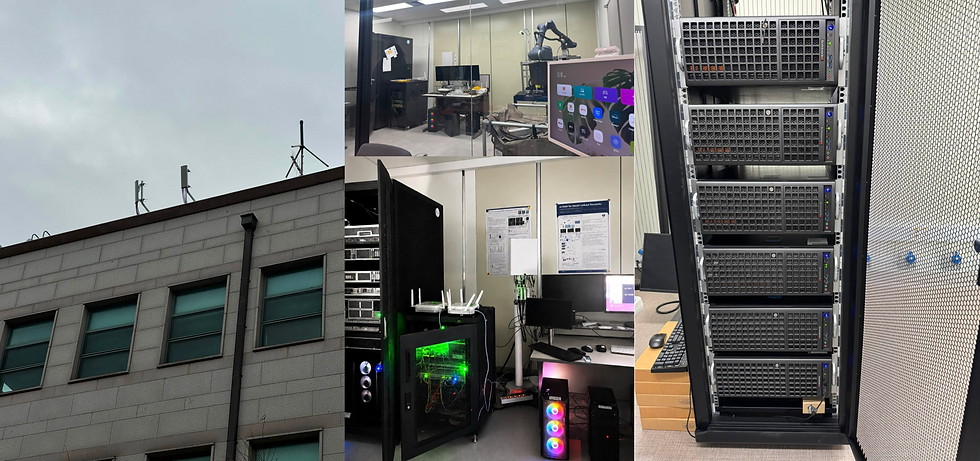
At Yonsei University, we are evaluating OCUDU with a CUDA-accelerated Layer 1 (L1) running on the NVIDIA DGX platform. In addition, we have conducted integration and interoperability testing using commercial O-RUs, UEs, and Keysight RuSIM on NVIDIA GPU platforms with an OAI-based vRAN CU/DU integrated with NVIDIA Aerial.
Our evaluation focuses on two primary objectives. First, we are assessing the variations in CPU utilization enabled by GPU acceleration while analyzing the associated processing overhead. Second, we are investigating AI-RAN use cases by enabling GPUs to simultaneously execute both RAN processing and AI inference workloads.
As the next phase of this work, we plan to extend the evaluation to additional CPU-GPU platforms and validate the system in both indoor and outdoor O-RU deployment environments. Our campus testbed operates in the 4.7 GHz private 5G band (n79) with a 100 MHz channel bandwidth.
Research Ecosystem & Collaborations
Our laboratory maintains international collaborations through MOUs and joint research with SUTD, Institute of Science Tokyo, Aalto University, Eurecom, University of Oulu, LiteON, Cumucore, Viavi, Keysight Technologies, LG Uplus and Yberg.
Research Alliances
Yonsei University participates in the AI-RAN Alliance, the Linux Foundation OCUDU Project, the O-RAN Alliance, and AINA (AI Network Alliance of Korea).
Funding
This work is supported by grants from the Institute of Information & Communications Technology Planning & Evaluation (IITP), funded by the Ministry of Science and ICT (MSIT), Republic of Korea, under the projects Development of a 5G-Advanced vRAN Research Platform and 6G AI-Native RAN & Core (6G ARROW, SNS JU).
Coming Soon
The technical details and evaluation results will be shared through upcoming technical reports, conference presentations, and publications later this year, including presentations planned for the AI-RAN Summit 2026 in Seoul.



댓글